I was interviewed by an AI and I’m never doing it again
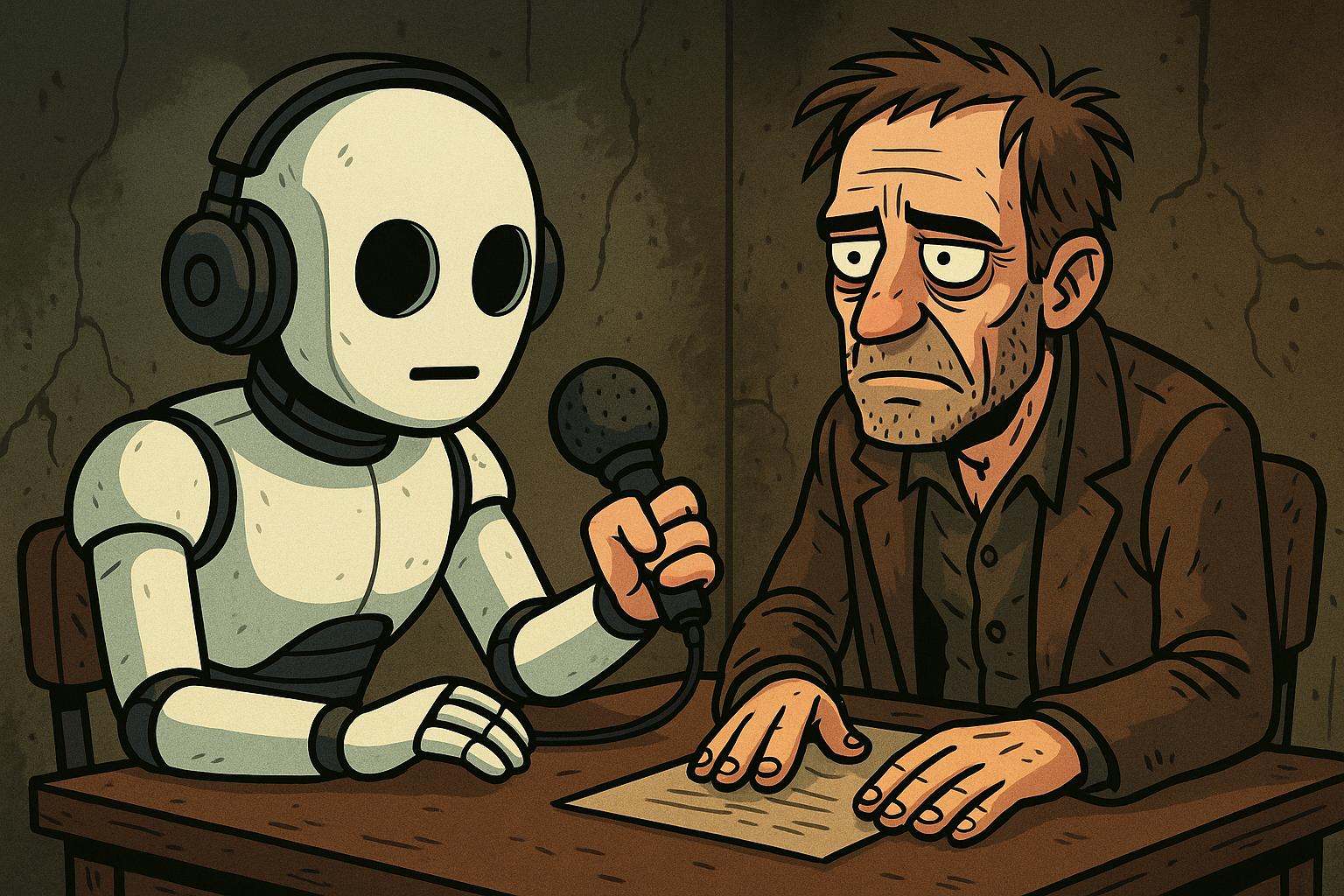
A few days ago I got a message by a recruiter asking me to do an initial screening for a role. I’m not actively looking to change jobs right now but what got my interest was that they’re using an AI platform for the first stage of the process. I’ve seen a few of these platforms pop up with various different offerings so I wanted to see what it’s like. I can confidently say, I won’t be interviewed by an AI ever again.
Black mirror
Have you seen the TV show Black Mirror? If not - it’s an anthology series where each episode takes a simple tech concept that exists in some form in the present like VR or brain chips, and then takes it to an extreme. This extreme usually aims to expose how said technology can lead to a reality where a grand vision of a utopia quickly turns into a dystopia.
Many of the episodes demonstrate how corporate greed and a ‘profit is king’ mindset erase the fundamental aspects of what humans are and what we’ve evolved to do - collaboration, kindness and connection. Those are things that are still exclusively human and we can’t afford to lazily use technology in domains and jobs where they are essential.
So what’s the problem with AI in recruiting?
Strike 1 - it’s impersonal
My curiosity was itching as I was opening the link to the recruitment platform. Is this going to be the future of recruitment? The platform loaded and I was presented with a view from my camera, audio and microphone check. I clicked the ‘Start interview button’ and the AI started speaking “Hey Martin, how are you doing today”. Immediately I got a sinking feeling - I’m literally talking to myself in a mirror (Black Mirror? 😃 ). I can say whatever I want and take as much time as I want because I’m alone at home. There was nobody on the other side - it’s just a digital entity which has no capacity to understand the subtleties of human interaction, emotion, enthusiasm for my profession, etc. And this soulless thing is supposed to evaluate me as a candidate to work with other humans!
This made me wonder - what type of person would use such a tool? I bet it would be someone who wants to reduce the number of interactions with people in the interest of “scaling recruitment” and “reducing costs”. It’s definitely not someone who likes working with humans! Which is exactly what recruitment is - a gauge of the basic question do I want to work with this person? So if someone can’t be bothered to look me in the eyes to check this, why should I bother applying for the role?
Strike 2 - past experience
For most roles, you’d like to hire someone who has experience that’s relevant to what you are recruiting for. The problem is that most interviews emphasise individual contributions way too much. One of the greatest management consultants thought that 95% of performance is attributable to the system and not only 5% to the individual. What this means is that often what’s more valuable is patterns of interaction on a team rather than a single person charging forward with his brilliance. Collaboration between people is what drives exceptional results not the mythical ‘10x engineer’.
This is an issue with traditional interviews too but in the context of an AI recruiter it just becomes more frustrating. How do you even quantify the value of a large scale refactor of a software architecture? Even if you could - would these metrics be meaningful in any way for the business as a whole?
That’s the kind of nuance that gets lost for an AI that’s been programmed to ask for your typical STAR answers. In my case, we got into a loop of the AI repeatedly asking for a quantifiable impact of my work in a context that just can’t be quantified.
Strike 3 - why should candidates bother?
Finally, if an employer can’t be bothered to talk to people… why would candidates be bothered to make an effort? AI apps for job seekers have also started popping up and it’s easy to end up in a situation where recruitment is a game of employer bots versus job candidate bots. Candidate bots will be optimised to give the perfect answer and then what? It’s very easy to game the system and you’ll end up with the same need you tried to remove - talking to a human. Ultimately, it would be a waste of time for both the employer and candidate.
The point here is that an AI cannot understand or evaluate the value of collaboration and communication between people. You need to care about who you’re recruiting if you want them to care and contribute to your company. That’s the social contract.
Overall, I think AI recruitment will be a fad that will eventually pass. There’s no underlying problem being solved here apart from a company saving some money. AI can be used for many awesome use-cases but it can’t be a substitute for humans. Not yet at least.